

| Bio source: Old Landmarks of Canton and Stark County, by John Danner, 1904 (The information on Richard was taken from the bio of Augustus R. Elson, also featured in the same book) |


| Richard Elson 1797 - 1879 |
Richard Elson was born in Brooke County, Virginia (now West Virginia), on the 12th of July, 1797, being a son of John Harris and Margaret (Wiggins) Elson. As a
boy he was independent and ambitious, and, having had a slight dispute with his father, he left home and crossed the Ohio river to Steubenville, Ohio, not far distant
from his home, where he began an apprenticeship at the shoemaker's trade, but within two or three weeks his better judgment prevailed and he returned to his home.
Owing to the conditions and exigencies of the time and locality he was denied more than the most limited educational advantages in his youth, but he became a man of
broad information and gained success in the face of the handicap of circumstances. His sturdy self-reliance and progressive spirit was early manifested, for at the age
of nineteen years he constructed a flat-boat and engaged in trading on the Ohio and Mississippi rivers, loading his rude craft with pork, flour, whiskey and other
products and floating the same down to New Orleans, where he would dispose of his cargo, after which he would walk back to Steubenville, a distance of about fifteen
hundred miles. He thus made the trip alone on five different occasions and had to traverse a country which to a large extent was an untrammeled wilderness, inhabited
only by Indians and the beasts of the forest. He continued in this line of enterprise about seven years, within which on one occasion he found on his arrival in New
Orleans that the scourge of yellow fever was raging and that all business was at a standstill, so that he could find no market for his cargo. He showed himself a master
of expedients, as did he many times in later life, for he placed his products on board the brig "Native" and thus transported the same to Savannah, Georgia, where he
sold his goods at a profit and then proceeded on another vessel to New York city, where he passed a few days and then returned to his home by the primitive means of
conveyance in vogue at that time. While he was devoting his attention to this migratory trading his parents and the other members of the family had left their home in
West Virginia, coming across the river into Ohio and taking up their abode in Stark county, the change having been made at his advice and solicitation. He abandoned
his trading business in 1823 and joined the family in this county. He purchased forty acres of land in Sandy township, later selling this and purchasing a greater section
in the same township, which is owned by Charles Long, and this he also sold and then took the quarter section now owned by his son by a second marriage, Corwin C.,
in Sandy township. This tract was government land and was entirely unreclaimed, so that there fell to him the task of instituting the work of felling the forest and
instituting the work of cultivation. He later purchased an adjoining forty acres of school land, so that the homestead comprised two hundred and forty acres.
About the year 1833 Richard Elson associated himself with John W. Smith in purchasing from Benjamin Tappan the southeast quarter of section 30 and the southwest
quarter of section 29, in Sandy township, Stark county, on the line of Carroll and Stark counties, the consideration being twelve hundred dollars. In 1834 they here
platted and laid out the town of Magnolia. There were some forty names selected from which to finally decide upon the title which should be given the embryonic
village, and the name of Magnolia was finally adopted, Mr. Elson having been impressed with the name from having seen the magnolia tree in full bloom in the south. In
1847 the town, and also the town of Zoar, were incorporated through a special act of the legislature, and this was the first post office of the name in the United States,
while by reference to the official post office guide the writer finds there are now twenty-three post offices in the Union to which the name Magnolia is applied. Having
thus been instrumental in founding a new town, Mr. Elson spared no pains to promote its progress. In 1834 he erected the original Magnolia Mills, the site of which at
the time of selection was heavily covered with underbrush, so that he had to crawl through on his hands and knees in order to make a survey of the situation to his
satisfaction. He placed the grist mill in operation and otherwise did much to improve and foster the development of the town. He was one of the influential men of the
county and was one of the best known sheep growers in this section of the state. His method was to loan out a number of sheep to the neighboring farms, asking in
return one-half the wool and one-half the increase, and through this means he largely laid the foundation for the fortune which he acquired. In 1877 the family received
notification from Washington to the effect that there was a sum of money due them from the government, the same being accrued and unpaid interest on government
bonds which had been called in, while the interest had not been collected. The subject of this sketch thereupon wrote a letter to the late lamented President McKinley,
who was at that time a member of congress from this district, giving him power of attorney to collect the interest, amounting to somewhat more than five hundred
dollars. Mr. McKinley refused to accept any remuneration for his services, saying that the Elson family had done enough for him in the days past to make it a pleasure
for him to make this slight recompense.
In politics Richard Elson was originally and old-line Whig, but upon the organization of the Republican party he ardently espoused its cause, holding it as the avowed
enemy of the institution of slavery, of which he had seen sufficient during his trading trips to the south to cause him to protest against it with all the ardor of his noble
and loyal nature. He remained a radical Republican until his death, which occurred on the 28th of August, 1879, at which time, among other words of high appreciation,
the Canton Repository spoke as follows "Richard Elson, who died at his home in Magnolia, on the 28th ultimo, at the advanced age of eighty-two years, was a
remarkable man, whose life is worthy of emulation, and his name should be revered and honored as one of the pioneers of this county, who during his younger days
contributed largely toward transforming this section, then a howling wilderness, into a garden of civilization and beauty. Commencing life poor, by his sagacity,
industry, frugality and energy, he acquired a competency, and he died as he had lived, honored and respected by all who knew him. May he rest in peace."
About the year 1827 Richard Elson was united in marriage to Miss Frederika Beogle, of Waynesburg, this county, and she died about three years later, leaving three
children. A few years later he married Miss Sarah Ann Brandon, of Holliday's Cove, Virginia (now West Virginia), and of this union three children were born, there
being three sons and three daughters in his family. Of the children of the last marriage those living are Corwin, a resident of Sandy Township, Stark County; Richard
of Magnolia; and Mary, of Oskaloosa, Iowa. Mrs. Sarah Elson died about 1847. John Harris Elson, father of the subject, was born in that section of Virginia which is
now comprised in West Virginia, the original American ancestors having come hither from Wales and located in Maryland, in the colonial epoch. John H. was a captain
in the war of 1812, and he died when a young man, his remains being now laid to rest at Mapleton, this county.
Clipping of Sept 4, 1879 Canton Repository, found in Aunt Mary Redmons (daughter of Richard and Sarah Ann) bible at Oskaloosa, Iowa:
Richard Elson founder of the Elson Mills at Magnolia, Ohio, still in operation, died at the age of 82 years (Aug 29, 1879). He was born in Virginia (Brooke County) in
1797 and emigrated to Ohio in 1820. He operated a flat boat on the Ohio River and Mississippi River, carrying merchandise from Steubenville, Ohio to New Orleans,
LA. Five times he returned on foot from Louisiana, through a country inhabited by Indians and wild animals.
On one occasion Mr. Elson arrived in New Orleans (1825) to find yellow fever raging there - and no sales for his merchandise. So he started for Savannah, Ga,
disposed of his goods and sailed to New York City. From there he made the trip on foot to Steubenville Ohio. Mr. Elson was a Whig and then a Republican. He was so
interested in politics that he often sent a four horse team from Steubenville to Canton and Massillon to gather a load of persons to attend a political meeting on the banks
of the Ohio. He furnished them food on route.
***death record index in Stark County, Ohio shows the death date as 25 Aug 1879
boy he was independent and ambitious, and, having had a slight dispute with his father, he left home and crossed the Ohio river to Steubenville, Ohio, not far distant
from his home, where he began an apprenticeship at the shoemaker's trade, but within two or three weeks his better judgment prevailed and he returned to his home.
Owing to the conditions and exigencies of the time and locality he was denied more than the most limited educational advantages in his youth, but he became a man of
broad information and gained success in the face of the handicap of circumstances. His sturdy self-reliance and progressive spirit was early manifested, for at the age
of nineteen years he constructed a flat-boat and engaged in trading on the Ohio and Mississippi rivers, loading his rude craft with pork, flour, whiskey and other
products and floating the same down to New Orleans, where he would dispose of his cargo, after which he would walk back to Steubenville, a distance of about fifteen
hundred miles. He thus made the trip alone on five different occasions and had to traverse a country which to a large extent was an untrammeled wilderness, inhabited
only by Indians and the beasts of the forest. He continued in this line of enterprise about seven years, within which on one occasion he found on his arrival in New
Orleans that the scourge of yellow fever was raging and that all business was at a standstill, so that he could find no market for his cargo. He showed himself a master
of expedients, as did he many times in later life, for he placed his products on board the brig "Native" and thus transported the same to Savannah, Georgia, where he
sold his goods at a profit and then proceeded on another vessel to New York city, where he passed a few days and then returned to his home by the primitive means of
conveyance in vogue at that time. While he was devoting his attention to this migratory trading his parents and the other members of the family had left their home in
West Virginia, coming across the river into Ohio and taking up their abode in Stark county, the change having been made at his advice and solicitation. He abandoned
his trading business in 1823 and joined the family in this county. He purchased forty acres of land in Sandy township, later selling this and purchasing a greater section
in the same township, which is owned by Charles Long, and this he also sold and then took the quarter section now owned by his son by a second marriage, Corwin C.,
in Sandy township. This tract was government land and was entirely unreclaimed, so that there fell to him the task of instituting the work of felling the forest and
instituting the work of cultivation. He later purchased an adjoining forty acres of school land, so that the homestead comprised two hundred and forty acres.
About the year 1833 Richard Elson associated himself with John W. Smith in purchasing from Benjamin Tappan the southeast quarter of section 30 and the southwest
quarter of section 29, in Sandy township, Stark county, on the line of Carroll and Stark counties, the consideration being twelve hundred dollars. In 1834 they here
platted and laid out the town of Magnolia. There were some forty names selected from which to finally decide upon the title which should be given the embryonic
village, and the name of Magnolia was finally adopted, Mr. Elson having been impressed with the name from having seen the magnolia tree in full bloom in the south. In
1847 the town, and also the town of Zoar, were incorporated through a special act of the legislature, and this was the first post office of the name in the United States,
while by reference to the official post office guide the writer finds there are now twenty-three post offices in the Union to which the name Magnolia is applied. Having
thus been instrumental in founding a new town, Mr. Elson spared no pains to promote its progress. In 1834 he erected the original Magnolia Mills, the site of which at
the time of selection was heavily covered with underbrush, so that he had to crawl through on his hands and knees in order to make a survey of the situation to his
satisfaction. He placed the grist mill in operation and otherwise did much to improve and foster the development of the town. He was one of the influential men of the
county and was one of the best known sheep growers in this section of the state. His method was to loan out a number of sheep to the neighboring farms, asking in
return one-half the wool and one-half the increase, and through this means he largely laid the foundation for the fortune which he acquired. In 1877 the family received
notification from Washington to the effect that there was a sum of money due them from the government, the same being accrued and unpaid interest on government
bonds which had been called in, while the interest had not been collected. The subject of this sketch thereupon wrote a letter to the late lamented President McKinley,
who was at that time a member of congress from this district, giving him power of attorney to collect the interest, amounting to somewhat more than five hundred
dollars. Mr. McKinley refused to accept any remuneration for his services, saying that the Elson family had done enough for him in the days past to make it a pleasure
for him to make this slight recompense.
In politics Richard Elson was originally and old-line Whig, but upon the organization of the Republican party he ardently espoused its cause, holding it as the avowed
enemy of the institution of slavery, of which he had seen sufficient during his trading trips to the south to cause him to protest against it with all the ardor of his noble
and loyal nature. He remained a radical Republican until his death, which occurred on the 28th of August, 1879, at which time, among other words of high appreciation,
the Canton Repository spoke as follows "Richard Elson, who died at his home in Magnolia, on the 28th ultimo, at the advanced age of eighty-two years, was a
remarkable man, whose life is worthy of emulation, and his name should be revered and honored as one of the pioneers of this county, who during his younger days
contributed largely toward transforming this section, then a howling wilderness, into a garden of civilization and beauty. Commencing life poor, by his sagacity,
industry, frugality and energy, he acquired a competency, and he died as he had lived, honored and respected by all who knew him. May he rest in peace."
About the year 1827 Richard Elson was united in marriage to Miss Frederika Beogle, of Waynesburg, this county, and she died about three years later, leaving three
children. A few years later he married Miss Sarah Ann Brandon, of Holliday's Cove, Virginia (now West Virginia), and of this union three children were born, there
being three sons and three daughters in his family. Of the children of the last marriage those living are Corwin, a resident of Sandy Township, Stark County; Richard
of Magnolia; and Mary, of Oskaloosa, Iowa. Mrs. Sarah Elson died about 1847. John Harris Elson, father of the subject, was born in that section of Virginia which is
now comprised in West Virginia, the original American ancestors having come hither from Wales and located in Maryland, in the colonial epoch. John H. was a captain
in the war of 1812, and he died when a young man, his remains being now laid to rest at Mapleton, this county.
Clipping of Sept 4, 1879 Canton Repository, found in Aunt Mary Redmons (daughter of Richard and Sarah Ann) bible at Oskaloosa, Iowa:
Richard Elson founder of the Elson Mills at Magnolia, Ohio, still in operation, died at the age of 82 years (Aug 29, 1879). He was born in Virginia (Brooke County) in
1797 and emigrated to Ohio in 1820. He operated a flat boat on the Ohio River and Mississippi River, carrying merchandise from Steubenville, Ohio to New Orleans,
LA. Five times he returned on foot from Louisiana, through a country inhabited by Indians and wild animals.
On one occasion Mr. Elson arrived in New Orleans (1825) to find yellow fever raging there - and no sales for his merchandise. So he started for Savannah, Ga,
disposed of his goods and sailed to New York City. From there he made the trip on foot to Steubenville Ohio. Mr. Elson was a Whig and then a Republican. He was so
interested in politics that he often sent a four horse team from Steubenville to Canton and Massillon to gather a load of persons to attend a political meeting on the banks
of the Ohio. He furnished them food on route.
***death record index in Stark County, Ohio shows the death date as 25 Aug 1879
Richard married Fredericka Sophia Boegel, daughter of Frederick and Elizabeth Boegel, July 12, 1827 in Stark Co., Ohio. They had the following children:
Charlotte Sophia Elson Born: January 29, 1828 Died: January 29, 1828
Charity Margaret Elson Born: January 29, 1828 Died: March 10, 1896 married William Harkness Greer, Sr. Born: June 23, 1814 Died: August 08, 1899
Catharine Elizabeth Elson Born: January 29, 1828 Died: December 05, 1895 married Thomas Hughes Whitacre Born: 1822 Died: 1890
Augustus Richard Elson Born: August 01, 1829 Died: April 25, 1904 married Margaret Elizabeth Ross Born: November 20, 1836 Died: February 11, 1915
Fredericka Sophia died August 2, 1829.
Richard Married Sarah Ann Brandon in 1833 and they had the following children:
Theodore Brandon Elson Born: May 23, 1835
Mary Fredericka Elson Born: March 11, 1838 Died: April 1906 married Reuben Redman
Corwin Clay Elson Born: December 20, 1841 Died: August 15, 1926 married Selena Letitia Rutter Born: December 16, 1849 Died: August 17, 1922
Sarah Anne Elson Born: August 30, 1845
Richard Elson Born: May 04, 1847 Died: March 06, 1936 married Catherine Anne Baxter Born: 1849 Died: 1926
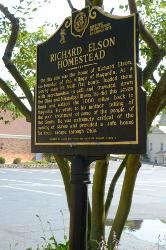
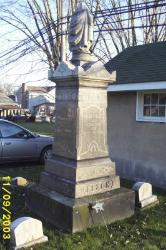
| Richard, Fredericka and Sarah Elson Memorial |